How Often Should You Really Get an Eye Test?
Most healthy adults should have an eye test every two years, the standard recommendation from the New Zealand Association of Optometrists. If you wear glasses or contact lenses, are over 65, have diabetes or a family history of eye disease, an annual check is usually advised. Children, and anyone noticing blurred vision, headaches or eye strain, should be seen sooner. The rule of thumb I give patients is simple: book the moment something feels off, rather than waiting until your glasses break.
Eye tests at a glance
|
How often should you have an eye test?
For most healthy adults, the answer is every two years. That is the standard recommendation from the New Zealand Association of Optometrists, and it is frequent enough to catch the gradual changes in vision and eye health that are easy to miss day to day.
An eye test is about far more than updating your glasses prescription. A regular check can pick up conditions such as glaucoma, cataracts and macular degeneration early, often before you notice any symptoms, and can even flag signs of wider health issues like diabetes or high blood pressure.
When you should go more often
A two-year gap suits people with healthy eyes and no risk factors. Maile Tarsau, optometrist and owner of Visique Eye Spy and the first Māori female optometrist in New Zealand, recommends an annual eye test if you:
- wear glasses or contact lenses
- are aged 65 or over
- have diabetes
- have a family history of eye disease
- notice your vision changing more quickly than usual.
If your sight changes suddenly, or you have an eye injury, do not wait for your next appointment. See an optometrist or an emergency clinic straight away.
Eye tests by age and life stage
How often you need an eye test shifts as you move through life. Here is a simple guide.
Children and the B4 School Check
Children’s eyes are still developing, and good vision is closely tied to learning. In New Zealand, children are usually screened before they start school through the B4 School Check, with a follow-up screen around intermediate age. Screening is a valuable safety net, but it is not a full eye examination. If your child squints, sits very close to screens, complains of headaches, or seems to be struggling at school, book a proper eye test. The earlier any issue is found, the easier it is to manage.
Adults in their 20s and 30s
Even with good vision, a two-yearly check is worthwhile through your 20s and 30s. It establishes a baseline your optometrist can compare against in future, and it catches the quiet conditions that do not announce themselves.
Adults 40 to 64
From around your early-to-mid 40s, many people find it harder to focus on close-up text, a normal age-related change called presbyopia. This is also when long hours on screens start to take a toll. If you are in this group, your optometrist may suggest checking in more often than every two years.
65 and over
After 65, an annual eye test is generally recommended. The risk of cataracts, glaucoma and macular degeneration rises with age, and these are exactly the conditions a regular exam is designed to catch early. Macular degeneration alone accounts for a large share of sight loss among older New Zealanders, and much of it is more manageable when found early.
During pregnancy
It is perfectly safe to have your eyes tested while you are pregnant, and it is worth doing if you notice any change in your vision. Hormonal changes can temporarily affect your eyes, and most of these settle after your baby arrives. A quick check rules out anything that needs attention and gives you peace of mind.
What happens during an eye test (and how long it takes)
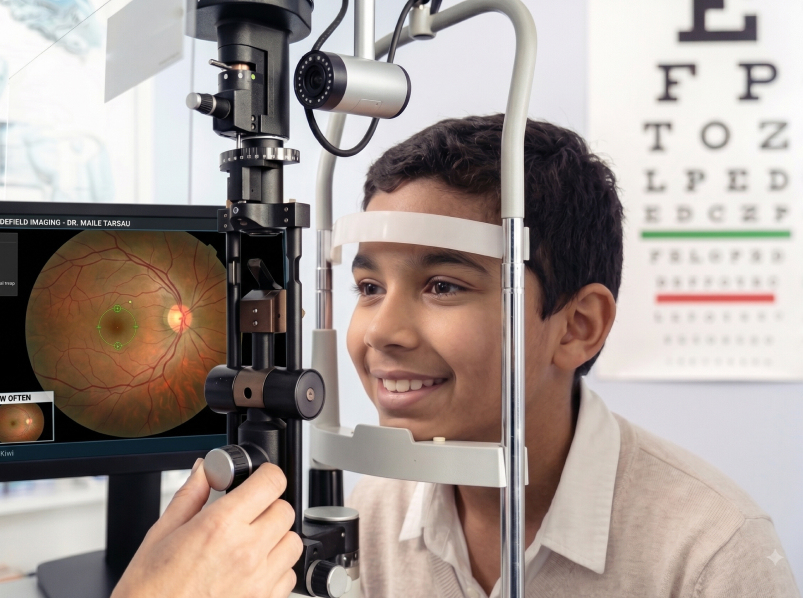
A comprehensive eye test usually takes about 30 to 60 minutes. Your optometrist will ask about your health and any vision concerns, test how clearly you see, and carry out a thorough check of your eye health, screening for conditions such as glaucoma, cataracts and macular degeneration. Extra tests, like colour vision, are added when needed. Think of it as a warrant of fitness for your eyes: not just “do you need new glasses?” but “are your eyes healthy?”
Signs you shouldn’t wait
Some symptoms are your cue to book sooner, whether or not your two years are up:
- blurred or fluctuating vision
- frequent headaches or eye strain
- difficulty seeing at night or while driving
- sensitivity to light, or halos around lights
- sudden flashes, floaters or any loss of vision (treat this as urgent).
If you spend long days on screens, the simple 20-20-20 habit can ease strain between tests: every 20 minutes, look at something about 20 feet (6 metres) away for 20 seconds. It will not replace an eye test, but it helps.
Eye tests and your driver licence
Renewing your New Zealand driver licence involves a vision check, and from age 75 it becomes part of the regular renewal process. Your optometrist can carry out the vision screening you need. It is worth knowing, though, that a licence vision check, a workplace screening or a diabetic retinal screen is not the same as a full eye examination. Each looks at one thing, while a comprehensive eye test looks at the whole picture.
Booking an eye test in Palmerston North
If it has been more than two years, or something simply feels off, it is time to book. At Visique Eye Spy on Broadway Avenue, we provide comprehensive eye examinations for patients of all ages in a relaxed, friendly setting, and after more than a decade of caring for local eyes, we keep the whole thing calm and straightforward.
Book your eye test with our Palmerston North team, or call us on 06 354 6666 to arrange a time that suits your week.
Frequently asked questions
How often should an adult get their eyes tested?
Most healthy adults should have an eye test every two years, in line with New Zealand Association of Optometrists guidance. Have one every year if you wear glasses or contacts, are over 65, have diabetes, or have a family history of eye disease.
How often should I get my eyes tested if I wear glasses?
If you wear glasses or contact lenses, an annual eye test is usually recommended so your prescription stays accurate and your optometrist can keep an eye on your overall eye health.
Can you get your eyes tested while pregnant?
Yes. It is safe to have your eyes tested during pregnancy, and it is a good idea if you notice your vision changing. Most pregnancy-related vision changes are temporary and settle after birth.
What is the 30-30-30 rule for eyes?
It is a memory aid for reducing screen strain. The version optometrists most often recommend is the 20-20-20 rule: every 20 minutes, look at something about 20 feet away for 20 seconds. It eases tired eyes between tests but does not replace a proper eye examination.